SOKOTO STATE GOVERNMENT’S EDUCATION DRIVE GAINS NATIONAL RECOGNITION
SOKOTO STATE GOVERNMENT’S EDUCATION DRIVE GAINS NATIONAL RECOGNITION
By Sani Umar
The commitment of the Sokoto State Government to revitalizing the education sector under the leadership of Governor Ahmed Aliyu continues to gain traction and recognition, not only within the state but across Nigeria. This renewed focus has attracted widespread commendation from reputable organizations, stakeholders, and development partners who acknowledge the administration’s deliberate and sustained efforts to reposition education.
At the heart of this growing recognition is the high benchmark set by the government, placing education at the center of its development agenda as a critical driver of socio-economic growth and long-term stability.
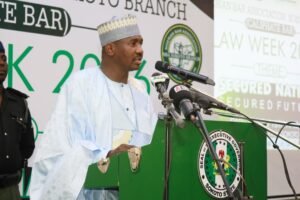
This recognition has been further reinforced by the Commissioner for Higher Education, Professor Isa Muhammad Maishanu, who commended the Governor for his administration’s expanding investment in the sector, an approach that is steadily attracting national attention and setting a standard for purposeful leadership.
According to the Commissioner, at a time when Nigeria’s education system is grappling with challenges such as underfunding and declining academic standards, Governor Aliyu has demonstrated a clear and unwavering commitment to repositioning education as a cornerstone of sustainable development.
The importance now attached to education by the present administration is not without context. Over time, the sector suffered significant neglect, resulting in dilapidated infrastructure, inadequate learning materials, and declining morale among educators.
Recognizing these setbacks, Governor Ahmed Aliyu made a firm commitment upon assuming office to reverse the trend and rebuild public confidence in the system. His administration’s resolve is anchored on the understanding that no meaningful development can be achieved without a strong and functional educational foundation.
Since coming into office, the government has implemented a comprehensive and strategic intervention framework aimed at addressing both structural and systemic challenges. At the basic and secondary education levels, this includes the renovation and construction of classrooms, provision of furniture, supply of instructional materials, and improvements in sanitation and hygiene to create a more conducive learning environment.
In addition, the administration has prioritized teachers’ welfare, while introducing monthly cash allocations to school heads to support routine maintenance and ensure efficient day-to-day school management.
Beyond the state’s borders, the administration’s interventions reflect a broader national outlook that underscores its commitment to advancing education as a collective national priority.
Recent approvals by the Governor include ₦10 million in support of the 6th Annual National Conference of the Faculty of Management Sciences at Usmanu Danfodiyo University, and another ₦10 million for the 44th Annual Conference of the Philosophical Association of Nigeria. These contributions highlight the government’s recognition of research, intellectual engagement, and policy dialogue as essential drivers of national development.
Further demonstrating support for academic excellence and institutional growth, the Governor approved a ₦40 million donation toward the combined 50th anniversary and 42nd convocation ceremony of Usmanu Danfodiyo University. Additional assistance has also been extended to other institutions across the country, including the University of Ilorin, Ahmadu Bello University, Al-Hikmah University, and the Abdullahi Fodio University of Science and Technology for its maiden convocation. These efforts reflect a leadership style that values collaboration, academic tradition, and the strengthening of Nigeria’s higher education ecosystem.
Within Sokoto State, however, the most profound transformation is taking place. The administration has invested heavily in the construction and renovation of lecture halls, modernization of learning facilities, and expansion of academic infrastructure across state-owned tertiary institutions. This is complemented by a strong focus on human capital development through continuous training and retraining of academic and non-staff, alongside the provision of modern instructional materials to enhance teaching quality and improve student outcomes.
In expanding access to higher education, the government has also introduced robust scholarship schemes for students studying both locally and internationally. Indigent students have not been left behind, as the administration continues to support them through the distribution of JAMB UTME and Direct Entry forms, as well as the organization of preparatory programmes designed to improve examination performance and increase admission success rates. These initiatives have significantly broadened opportunities for young people, ensuring that financial constraints do not hinder academic aspirations.
The administration’s collaborative engagement with federal institutions within and outside the state has further strengthened academic standards and fostered a more integrated and resilient education system. These achievements are firmly anchored in the Governor’s 9-Point Smart Agenda, where education occupies a central position as a catalyst for socio-economic transformation.
Collectively, the consistency, scale, and impact of these interventions have not only transformed the educational landscape in Sokoto State but have also drawn national attention as a model worthy of emulation. With sustained commitment and strategic investments, the administration continues to lay a solid foundation for a future driven by knowledge, innovation, and inclusive development, reaffirming its dedication to ensuring that education remains a powerful tool for empowerment and progress.
–End–