
Sokoto Information Commissioner urges Judicial Reporters to uphold highest ethical standards
From Bashir Rabe Mani in Sokoto
The Sokoto State Commissioner of Information, Alhaji Sambo Bello Danchadi, has urged journalists covering judicial activities to uphold the highest ethical standards by ensuring balance, objectivity, and factual accuracy in their reports.
“As practitioners entrusted with informing the public, journalists must always remember that credibility is the foundation of journalism.
“Public trust in the media is built when reports are verified, responsible, and free from bias or misinformation.”
According to him, the workshop is therefore an important opportunity for media professionals to deepen their knowledge of judicial reporting, understand legal terminologies and court procedures, and sharpen their skills in responsible news writing
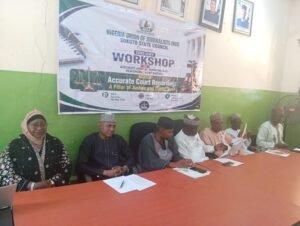
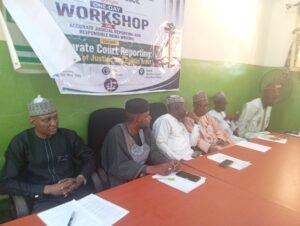
He spoke on Saturday in Sokoto at a one-day Workshop on Accurate Judicial Reporting and Responsible Repotting, organized by the State Council of the Nigeria Union of Journalists (NUJ).
Our Correspondent reports that the workshop had as theme: “Accurate Court Reporting: A Pillar of Justice and Public Trust”.
The Commissioner said that the workshop was aimed at strengthening the capacity of journalists in accurate judicial reporting and responsible news writing.
He said, “First and foremost, I wish to commend the leadership of the NUJ Sokoto State Council for organizing this timely and highly relevant workshop.
“The choice of theme, “Accurate Court Reporting: A Pillar of Justice and Public Trust,” reflects the vital role the media plays in safeguarding justice, promoting accountability, and sustaining democracy.
“The judiciary remains one of the most sensitive and critical institutions in any democratic society. Court proceedings and judicial pronouncements influence governance, and affect the lives of citizens.
” Therefore, reporting judicial matters requires professionalism, accuracy, fairness, and a deep understanding of legal processes.
“Inaccurate or sensational reporting of court proceedings can mislead the public, damage reputations, undermine confidence in the justice system, and in some cases, interfere with the course of justice.”
Danchadi stated that he strongly believed that the knowledge gained will contribute immensely toward improving the quality of reportage in our state and beyond.
“The government of Sokoto State under the leadership of Ahmad Aliyu remains committed to supporting initiatives that promote professionalism, ethical journalism, and responsible dissemination of information.
” We recognize the media as strategic partners in development, peacebuilding, and democratic governance.
“It is on record that the Ahmed Aliyu administration has undertaken several training programs for working Journalists and Social Media practitioners in the State and more of such trainings are in the pipeline.
“I therefore urge participants to actively engage during the sessions, ask questions, share experiences, and utilize this opportunity to enhance your professional competence.
“Before I conclude, let me once again appreciate the organizers, resource persons, and all stakeholders who contributed to the success of this workshop.
“I also encourage the NUJ to sustain such capacity-building programmes for journalists across various beats.
The State Commissioner of Justice, Barrister Nasir Muhammad Binji, represented by the Permanent Secretary, Barrister Lema Wali, said the NUJ remains a key stakeholder in the administration of justice in the country.
He added that judicial reportage must therefore be accurate, factual, balanced and professionally presented.
According to Barrister Binji, sensational reporting of judicial proceedings can be dangerous to peace and stability of the country.
Also speaking, the Permanent Secretary, Sokoto State Ministry of Innovation and Digital Economy, Dr Nasir Daniya, who commended the NUJ for organising the workshop, said that accurate reporting requires one to be abreast of proceedings and the terminologies used in Courts.
Also speaking, the Director-General, Media and Publicity, Government House, Sokoto, Alhaji Abubakar Bawa, underscored the efforts to ensure efficiency in the media landscape in the state.
Alhaji Abubakar also said that the administration of Gov. Ahmed Aliyu Sokoto emphasizes the training and retaining of journalists and the generality other civil servants in the state.
He recalled that a myriad of such routine trainings had be successfully conducted by the state government for social media practitioners and the conventional media workers in the state, promising that more of such noble gestures are being packaged.
The Director-General further advocated more training for journalists in the state on Media Law especially as the 2027 general elections are fast approaching.
The Chairman of the State Council of the NUJ, Alhaji Usman Muhammad Binji, said the workshop was to strengthen the capacity of journalists in judicial reporting and promote responsible news writing in our profession.
He said, “Judicial reporting is one of the most sensitive areas of journalism. It requires accuracy, fairness, balance, patience, and a high level of ethical responsibility.
“The way journalists report court proceedings directly influences public understanding of the justice system and shapes public trust in both the judiciary and the media.
“This workshop has therefore been carefully designed to equip participants with practical knowledge and deeper understanding of judicial processes, legal boundaries, ethical considerations, and responsible news writing.
“Participants will also gain insight into the proper use of court documents, interpretation of legal proceedings, and the role of journalists in protecting the integrity of the justice system.”
Binji appreciated the Sokoto State Government under the able leadership of his excellency Dr Ahmed Aliyu sokoto for support to NUJ Sokoto State council.
“We appreciate all stakeholders and partners who supported this initiative.
“Their support demonstrates a shared commitment to strengthening journalism and promoting public trust through accurate and responsible reporting.
”As we begin this workshop, let us reflect on the vital role we play as journalists. Our reports should educate and enlighten the public, not create confusion.
“They should promote justice, fairness, and accountability while upholding the ethics and integrity of our profession.”
