Aminchi Centre Faults MURIC’s 14-Day Ultimatum to Defence Minister Over Sokoto Killings
Bashir Rabe August 26, 2026 0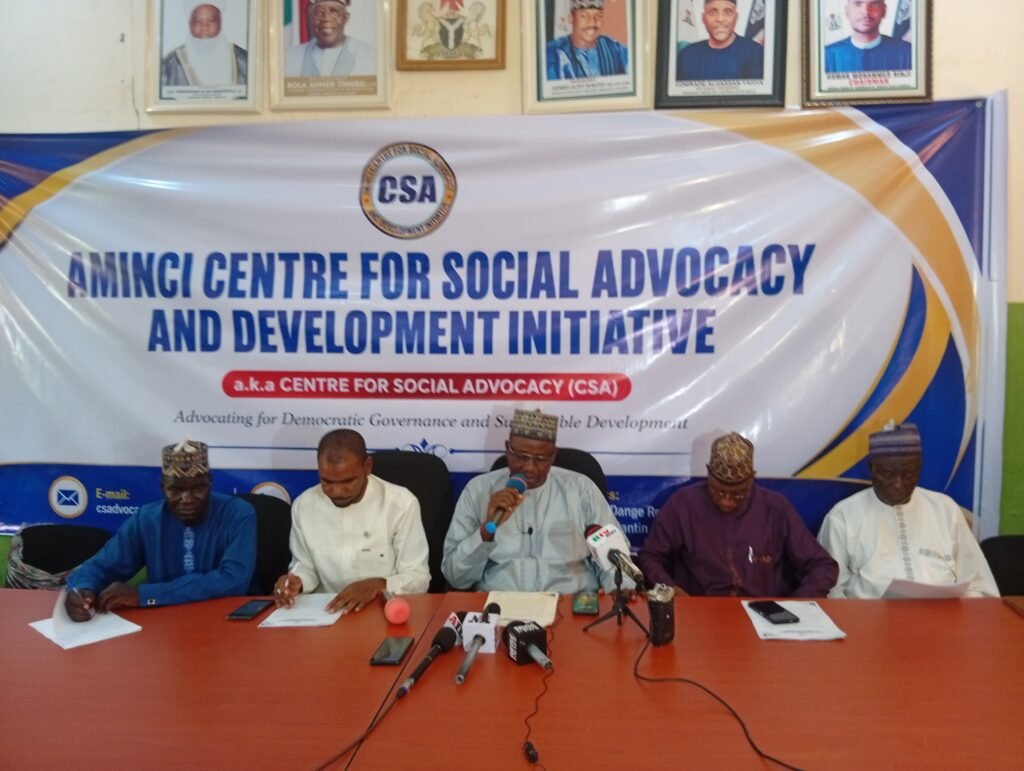
Aminchi Centre Faults MURIC’s 14-Day Ultimatum to Defence Minister Over Sokoto Killings
From Bashir Rabe Mani in Sokoto
The Aminchi Centre for Social Advocacy and Community Development has criticised the 14-day ultimatum issued by the Muslim Rights Concern (MURIC) to the Minister of Defence, General Christopher Gwabin Musa (Rtd), over the worsening insecurity in Sokoto State.
MURIC, through its Executive Director, Prof. Ishaq Akintola, had reportedly demanded that the Defence Minister stop the killings in the state within 14 days or resign.
Reacting on Wednesday in Sokoto, the Centre’s Chairman and Chief Executive Officer, Brahim Abdullahi Shuni, said the Aminchi Centre described the demand as an oversimplification of a complex national security challenge and urged MURIC to focus on constructive engagement rather than what it termed scapegoating.
The organisation said Nigerians had every right to demand effective security and accountability from government, but argued that responsibility for national security could not be placed solely on the Minister of Defence.
According to the Centre, the Ministry of Defence operates within a broader institutional framework involving the Defence Headquarters, the Nigerian Army, Nigerian Navy, Nigerian Air Force and other defence institutions.
It maintained that the Defence Minister is primarily responsible for policy, strategic direction, oversight, administration, procurement and coordination within the defence sector, rather than the day-to-day operational command of every military formation or engagement.
The Centre further cited the 1999 Constitution, particularly Section 218, arguing that the President, as Commander-in-Chief of the Armed Forces, has the constitutional power to determine the operational use of the military.
It, therefore, urged MURIC to consider the roles of the Presidency, Service Chiefs, security and intelligence agencies, state governments, traditional institutions, communities and citizens when assessing the country’s security challenges.
The organisation also challenged MURIC to demonstrate its own contribution to combating insecurity beyond issuing public statements and ultimatums.
It asked the group to disclose what intelligence it had supplied to security agencies, how many communities it had assisted with early-warning mechanisms, and what programmes it had undertaken to discourage recruitment into violent groups and support victims of terrorism, banditry and kidnapping.
The Centre also questioned what it described as the need for broader engagement on insecurity in Kwara State, where MURIC has previously made public interventions on security, communal and religious matters.
“Those who seek accountability from government must equally demonstrate what they themselves are contributing to the solution,” the organisation said.
The Centre argued that tackling insecurity requires cooperation among security agencies, governments, religious and traditional leaders, community organisations and citizens.
It also called for stronger community intelligence, early-warning systems, cooperation between religious leaders and security agencies, support for victims and increased public participation in the fight against terrorism, banditry, kidnapping and violent crime.
While defending the Defence Minister against what it described as an unfair personalisation of the security crisis, the organisation stressed that this should not be interpreted as opposition to accountability.
It said the Minister of Defence, the Armed Forces and other security institutions should be judged on their legally assigned responsibilities, available resources, institutional mandates and measurable results.
The Centre also described the demand for Sokoto to become impregnable and unassailable within 14 days as unrealistic, arguing that security operations could not reasonably be judged by a guarantee that no attack would occur within a fixed period.
It called instead for continuous assessment based on improvements in intelligence gathering, prevention of attacks, disruption of criminal networks, rescue of victims, protection of vulnerable communities and prosecution of offenders.
The organisation also defended Gen. Musa’s connection to Sokoto, describing him as “a son of the soil of the Seat of the Caliphate” who had shared the experiences of the people and contributed to community development in the area where he spent much of his early life.
The Aminchi Centre concluded that the solution to Nigeria’s insecurity lies in stronger intelligence, better coordination, adequate resources, effective leadership, professional military operations, community cooperation and responsible governance.
It stressed that while MURIC was entitled to demand accountability, the organisation was not constitutionally empowered to determine the tenure of a Federal Minister, whose appointment and removal are subject to the constitutional powers and processes of the Federal Government.
The Centre urged all stakeholders to shift the focus from blame to collective action, stressing that “security is everybody’s business.”