World Children’s Day: UNICEF Seeks Stronger Media Advocacy, Collective Action to Advance Children’s Rights
World Children’s Day: UNICEF Seeks Stronger Media Advocacy, Collective Action to Advance Children’s Rights 
From Bashir Rabe Mani in Sokoto
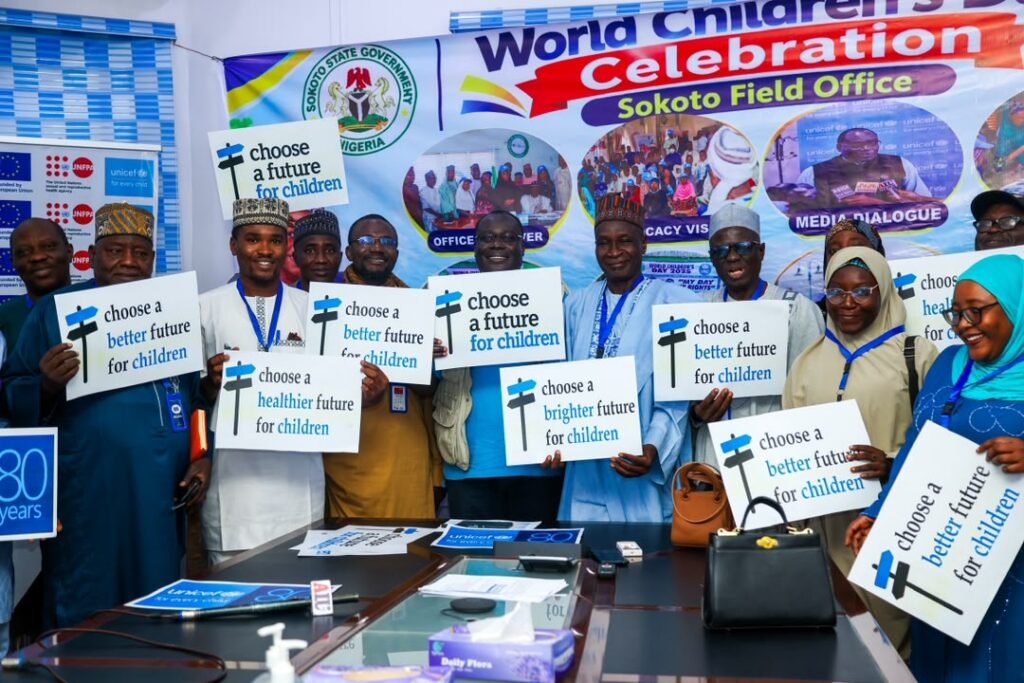
As the world commemorates World Children’s Day 2026, UNICEF has called on media organisations across Sokoto, Kebbi and Zamfara States to strengthen advocacy, promote public accountability and amplify efforts towards the protection and fulfilment of every child’s rights.
Speaking during a media briefing organised by the UNICEF Sokoto Field Office to mark the global celebration, the Chief of Field Office, Dr Michael Juma, described journalists as important duty-bearers in advancing children’s rights, urging them to provide balanced coverage that highlights development achievements while drawing attention to persistent gaps affecting children’s wellbeing.
He reaffirmed UNICEF’s commitment to working with government institutions, development partners, traditional and religious leaders, communities and other stakeholders to ensure that every child has access to quality and inclusive education, healthcare, nutrition, safe water, social protection and a protective environment.
Progress in advancing children’s rights
Highlighting key achievements recorded through UNICEF’s partnership with the three state governments, Dr Juma outlined progress across several critical programme areas.
Education: UNICEF has supported the identification of approximately 624,000 out-of-school children across the three states, with about 68,000 children reached through re-enrolment efforts. Additionally, approximately 98,000 children have benefited from the Teaching at the Right Level (TaRL) approach, which improves foundational literacy and numeracy.
UNICEF continues to support teacher professional development, provision of learning materials, accelerated basic education, integrated Qur’anic education and innovative learning opportunities, including radio-based education and the Nigeria Learning Passport, particularly for children affected by insecurity and displacement.
Health and immunisation: In Sokoto Kebbi and Zamfara States, approximately 7.8 million children were reached with measles-rubella vaccination, while over five million children were vaccinated during the last concluded polio campaign, according to figures presented at the briefing.
In Kebbi State, where malaria vaccination has been introduced, approximately 148,000 children have received the first dose and 130,000 the second dose of the malaria vaccine.
The Chief emphasised that strong health systems and immunisation programmes provide an essential foundation for children’s survival, development and ability to benefit from education and other essential services.
Nutrition: UNICEF continues to support government efforts to prevent and treat malnutrition. The Chief acknowledged the contributions of the Sokoto and Zamfara State Governments, which committed approximately ₦100 million and ₦500 million respectively towards the procurement of Ready-to-Use Therapeutic Food (RUTF) for the treatment of children with severe acute malnutrition.
Social protection and healthcare: The Chief also acknowledged the Kebbi State Government’s contribution of approximately ₦540 million towards free medical care for children.
Through support for social health insurance, UNICEF has also helped strengthen access to healthcare, with approximately 86,000 beneficiaries in Zamfara, 18,000 in Sokoto and 10,000 in Kebbi reported under the respective initiatives.
Child protection: UNICEF has supported the development of child protection legislation, Family Court Rules and social protection policies to strengthen the protection, rehabilitation and reintegration of vulnerable children, including children in conflict with the law.
The Field Office has also supported the establishment of a Special Care Baby Unit in Sokoto State, with similar initiatives being advanced in Kebbi and Zamfara States to improve care for premature and low-birth-weight babies.
Addressing the remaining challenges
Despite these achievements, the Chief acknowledged that considerable work remains, particularly in ensuring that identified out-of-school children are fully reintegrated into the education system.
He noted that while approximately 624,000 out-of-school children had been identified across the three states, only about 68,000 had so far been reached through re-enrolment efforts, underscoring the need for stronger government leadership, sustained investment and community mobilisation.
Responding to questions on declining global funding, Dr Juma explained that the funding challenge was not limited to Nigeria. He noted that UNICEF was expanding its resource mobilisation efforts to sustain support for state governments and essential services.
He also assured journalists that education programming across the three states had not been affected by the funding decline experienced earlier in the year.
On reaching children in hard-to-reach and insecure communities, he explained that UNICEF works with government structures through field facilitators and third-party monitoring arrangements to support service delivery, track progress and ensure that vulnerable children and women are not excluded from essential interventions.
Media as partners in advancing children’s rights
The Chief called for stronger coordination at ward and local government levels, stressing that the successful delivery of services depends on the active participation of government institutions, development partners, civil society organisations, traditional and religious leaders, community structures and parents.
He particularly urged journalists to use their platforms to enlighten communities, generate demand for essential services, highlight emerging challenges and hold stakeholders accountable for commitments made towards children.
He also invited media organisations to participate in future field visits to witness the impact of UNICEF-supported interventions, particularly in education, nutrition, social protection and other critical programme areas.
Upcoming advocacy opportunities
The media briefing also highlighted upcoming opportunities for stronger collaboration with journalists, including the December 2026 polio immunisation campaign scheduled for 5–11 December across the three states.
UNICEF called on media organisations in Sokoto, Kebbi and Zamfara to support pre-campaign mobilisation, public awareness and community engagement to encourage parents and caregivers to present eligible children for vaccination.
The Field Office further encouraged journalists to participate in planned field engagements to document interventions and amplify the voices and experiences of children and vulnerable households.
UNICEF’s message on World Children’s Day
As the world marks World Children’s Day under the theme “My Day. My Rights. My Future.”, UNICEF reiterates that every child, irrespective of their circumstances, deserves the opportunity to survive, learn, grow and fulfil their potential.
Securing children’s rights requires more than policy commitments. It demands sustained investment, effective service delivery, community ownership and collective accountability.
UNICEF calls on all stakeholders, particularly the media, to turn commitments into action and ensure that no child is left behind.