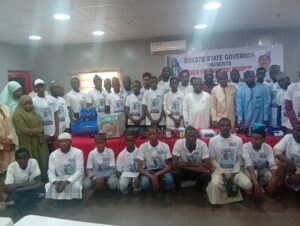
Sokoto Gov’t trains 50 youths on phone repairs, solar installation for sustainable employment
Bashir Rabe October 29, 2026 0Sokoto Gov’t trains 50 youths on phone repairs, solar installation for sustainable employment

From Bashir Rabe Mani in Sokoto
The Sokoto State Government has commenced a two-week intensive skills acquisition training for 50 youths on handset repairs and solar installation and repairs as part of its sustainable youth empowerment drive.
Speaking on the rationale behind the programme, the Commissioner for Budget and Economic Development, Dr. Bashir Muhammad Achida, said the best way to empower a youth is not through temporary cash handouts, but by providing life skills and hands-on skills that will enable them to live a dignified life and help themselves.
“The best way to empower a youth is to provide them with skills, life skills, and hands-on skills, so that they can live a dignified life and also to be able to help themselves.
” It’s not just about temporary empowerment where people are given cash handouts or whatever.
“His Excellency asked us to plan something that will have long life effects and also transform the economy of the state,” Dr. Achida said.
He noted that Sokoto State has one of the largest youth populations in the country, describing the youth as one of the biggest economic opportunities of the state alongside solid minerals and agriculture.
“You realize that empowering youth is one of our opportunities in the state. The opportunities as far as the economic development are concerned are four or five.
“Number one is the solid minerals, number two agriculture, and number three is the youthful population that we have.
“If we want to leverage on the youth that we have, that are idle, to make them more productive and to support themselves and their families economically,” he explained.
On the scope of the training, Dr. Achida said all facilitators, equipment and personnel are already on ground, with the 50 youths to be trained on handset repairs and solar installation and repairs.
“We are to train them on handset repairs. As you know, everyone now handles a handset and it is part of things that are really required in this environment. Then also solarization.
“You know, green energy is the way to go. A lot of houses now are onto solar. And so when you have these necessary skills for repairs, in fact, you find out each and every one of us is struggling to find an expert that will handle his solarization or solar repairs. So having these skills is I think the right track,” he said.
Responding to questions on whether the programme will be expanded beyond the initial 50 beneficiaries, the Commissioner said the current batch is just a pilot aimed at ensuring quality and intensive training.
“This is just a start-up and given the quality that we want to give, you have to start small because we want to give them an intensive training.
“You can’t have 1,000 youth at the same time and have them all together for two weeks. So we have worked on that model to see how we can have 50 youth who are ready to sacrifice these two weeks.
” Then other set of youth will also tell us when they have this time to sacrifice and then we bring them on board. So this job is starting.
“We are starting with 50 to see the impact and to see how it’s going to work. And then later on we scale up,” he stated.
On motivation to ensure the trainees remain committed, Dr. Achida said the selection was based purely on interest, coupled with provision of feeding, transportation support and a conducive learning environment.
“We went out, we asked them that is what we want to do. Those that are interested should showcase their interest and they did.
“Now they have that motivation behind them that they want to do. Number two, we provide them with support, feeding, transportation, so that at least they will be comfortable here.
“And you can see the environment itself is very conducive for learning and training,” he said.
He added that the government has put in place a post-training support mechanism to prevent the failure of past empowerment schemes where starter packs were sold off.
“We have starter packs that we are going to give them and also we are employing Monitoring and Evaluation to make sure that each and every one of them is working, not that the previous kind of empowerment where at the end, the starter pack will be sold and then everything will be lost. So there are starter packs and then there are start-up capitals,” he assured.
On how the youths were selected, the Commissioner stressed that interest and availability were the key criteria.
“We look at those with the interest because when you want to provide training, number one issue is interest. Those that have interest and time to spare for the training.
” We do what we call snowballing through individuals, we get to know those who are interested in this kind of skills and we brought them together because if they don’t have interest they will not concentrate and then it might not be productive as intended,” he concluded.