FROM CHALK AND TALK TO CHILDREN WHO CAN THINK: NTI AND UBEC ARM TEACHERS WITH A NEW WAY TO TEACH NIGERIA

 FROM CHALK AND TALK TO CHILDREN WHO CAN THINK: NTI AND UBEC ARM TEACHERS WITH A NEW WAY TO TEACH NIGERIA
By Bashir Rabe Mani in Sokoto
The value of a curriculum is realized only in the learning it makes possible, and for every child in basic education in Nigeria, that value should be evident in lessons that are clear, engaging and connected to everyday life.
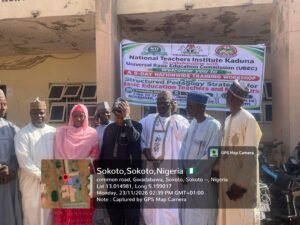
That simple truth sits at the heart of the new Training Manual on Structured Pedagogy Strategies for Basic Education Teachers and Education Managers, produced by the National Teachers’ Institute, Kaduna, in collaboration with the Universal Basic Education Commission, in November 2026, and presented by the Director-General of the National Teachers’ Institute, Prof. Sadiya Sani Daura, represented by Dr. Salmanu Maiwada. Achieving that kind of learning requires teachers who can translate curriculum expectations into effective instruction and education managers who can provide the leadership and support that good teaching needs, and it is precisely that capacity that this manual and the nationwide training built around it were designed to strengthen.
The revised Basic Education Curriculum developed by the Nigerian Educational Research and Development Council, as approved by the Federal Ministry of Education, provides the foundation for this responsibility. Its successful implementation depends on the ability of schools to turn prescribed content into meaningful learning experiences that accommodate differences in learners’ abilities, languages and backgrounds.
In response to this need, the National Teachers’ Institute, Kaduna, in collaboration with the Universal Basic Education Commission, developed the Nationwide Training on Structured Pedagogy Strategies for Basic Education Teachers and Education Managers.
The content draws on a needs assessment conducted by the Institute and is aligned with the revised curriculum and the UBEC Teacher Professional Development Framework, with the general objective of strengthening participants’ capacity to plan, deliver, assess and support inclusive, culturally responsive and activity-based instruction through structured pedagogy.
Structured pedagogy provides a purposeful connection among learning objectives, lesson content, instructional materials, classroom activities and assessment. It enables teachers to introduce ideas in manageable stages, demonstrate their application, guide practice and check understanding before proceeding.
This organization also creates room for thoughtful adaptation, allowing teachers to respond to learners’ needs while maintaining a clear instructional direction. In her foreword to the manual, presented on her behalf by Dr. Salmanu Maiwada, Prof. Sadiya Sani Daura encouraged every participant to approach the training with openness, professional curiosity and a commitment to improvement, because its lasting value will be seen in the quality of classroom practice and the progress children make, and by applying what is learned and supporting one another beyond the workshop, teachers and managers can give practical expression to curriculum reform and expand the opportunity for every child to succeed.
The workshop begins by examining pedagogy, andragogy and heutagogy as foundations for understanding how children and adults learn and how greater learner independence can be encouraged. It then considers structured, constructive and digital pedagogical frameworks, establishing a basis for selecting approaches suited to Nigerian basic education classrooms. From that foundation, attention shifts to lesson planning that draws on learners’ experiences. Indigenous knowledge, local folktales, familiar environmental contexts and prior understanding are explored as resources for making curriculum content accessible.
Bilingual and multilingual bridging is also considered as support for comprehension, within applicable language and curriculum provisions. The message is clear: a good lesson does not start with a textbook, it starts with the child, with what the child already knows, with the language the child speaks at home, with the stories the child hears in the village, and with the world the child sees every day.
From planning, participants move to the organization of practical learning. They explore how locally available and recyclable materials can support improvised mathematics and science kits, hands-on investigations and other classroom activities, with appropriate attention to pacing, safety and resource management. Think-pair-share, small-group inquiry, open-ended questioning and peer tutoring demonstrate how clearly defined tasks and responsibilities can promote productive interaction.
The manual insists that effective teaching does not always require expensive resources.
Bottle tops, pencils, stones, empty cartons, leaves, water, sand and other everyday objects can become powerful teaching aids when a teacher knows how to use them with purpose. Activity-based learning engages learners through exploration, experimentation, discussion, collaboration, problem-solving and practical demonstrations, shifting learning from teacher-dominated instruction to meaningful learner participation, and good pacing ensures that no child is rushed and no lesson is left unfinished.
Assessment is inextricably integrated into these learning cycles through performance tasks, observation checklists, student portfolios and self-evaluation rubrics. Metacognitive reflection complements these instruments by enabling learners to articulate their cognitive processes, diagnose learning bottlenecks and identify adaptive strategies.
Ultimately, participants synthesize their acquired competencies into actionable implementation roadmaps, sustained by personal benchmarks and collaborative professional learning communities.
The training itself reflects the approach it promotes. Each session establishes its objectives, activates relevant prior knowledge and proceeds through explanation, demonstration, guided practice and independent application.
Facilitators use brief checks for understanding to adjust their pace and provide timely feedback, so that participants experience the instructional sequence they are expected to apply or support in their schools. Practical assignments produce usable lesson plans, teaching resources and assessment tools.
Microteaching allows teachers to rehearse strategies and refine them through peer and facilitator feedback, while education managers practise lesson observation, constructive professional dialogue and support planning. Closing reflections connect these activities to specific actions participants will undertake after the workshop.
The manual is blunt about one hard truth that every teacher in Nigeria knows. Teacher professional development only succeeds when workshop concepts translate into consistent, everyday classroom practices and measurable gains in student learning. Attendance, active participation and theoretical knowledge are starting points rather than the final goal.
Research across sub-Saharan Africa, including UNICEF and UBEC Teacher Professional Development frameworks, shows that one-off workshops rarely change classroom habits unless teachers have practical implementation roadmaps, clear performance indicators and peer support structures.
That is why the final part of the manual is devoted to sustaining change, action planning and community of practice. Teachers are guided to integrate structured pedagogy principles, approved lesson plans, teachers’ guides and local resources into daily instruction, to apply differentiated instruction and continuous formative assessment to ensure equitable learning outcomes, to establish SMART personal success metrics to monitor teaching effectiveness and student achievement, and to design an actionable implementation roadmap and participate actively in school-based Communities of Practice.
A Community of Practice, as defined in the manual, is a collaborative group of teachers within a school, subject department or local cluster who meet regularly to share practical experiences, solve classroom challenges and improve student outcomes, with shared commitment, consistent meeting schedules, constructive non-judgmental peer support, practical problem-solving and evidence-based reflection.
In the end, the manual presented by Prof. Sadiya Sani Daura through her representative, Dr. Salmanu Maiwada, is not just a training document. It is a call to action. It tells the Nigerian teacher that the child in front of them is not a passenger but a driver of learning, that the classroom is not a place for copying notes but a place for thinking, doing, questioning and discovering, that local language is not a barrier but a bridge, that a lack of expensive materials is not an excuse but an invitation to improvise, and that assessment is not punishment but a guide to help the teacher know who has understood and who still needs help. It tells the education manager that leadership is not inspection but support, not fault-finding but coaching, not paperwork but walking into classrooms, watching lessons, giving feedback and celebrating good teaching. If the teachers and education managers trained under this programme truly carry this manual back to their schools, then the real story will not be told in Kaduna or in Sokoto or in Abuja.
It will be told in a Primary classroom in Sokoto where a child who could not multiply yesterday can multiply today with bottle tops, in a Basic classroom in Enugu where a child reads her first sentence with confidence, and in a school in Lagos where a teacher who once talked for forty minutes now listens, guides and watches every child learn.