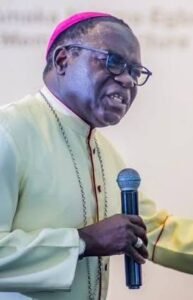
Bishop Kukah’s Easter message
Faith and Hope in Times of Turbulence
Easter Message 2026
Bishop Matthew Hassan Kukah, Catholic Bishop, Sokoto Diocese
1: Easter in a Time of Turbulence
I just love Pilots. Not just their impeccably smart attire, but their air of confidence. My concern is with those assuring words after take-off when they make contact from the cockpit: “Ladies and gentlemen, although we expect some slight turbulent winds ahead, we will do our best to avoid them. Nothing to worry about. We will endeavour to make your journey as comfortable as possible. Fasten your seat belts, relax and enjoy the flight.” Relax and enjoy the flight? How? I can never understand why these pilots expect us to fasten our seat belts, yet relax and enjoy the flight after these announcements. Yet, this alluring confidence is their trademark. Every leader needs a way to assure citizens that they are in charge even in the midst of turbulence. There is hardly a better time to think about surviving turbulence than at Easter, a time when Christians celebrate the ultimate triumph over the turbulence of death.
2: Nigeria’s endless Turbulence
Turbulence is Nigeria’s surname. A nation founded in the turbulence of colonialism, sank deeper into a self-generated turbulence by the local elites. The persistence of the turbulence is the result of a combination of factors. We continue to wonder, is it the (in)experience of the several pilots who over the years cannot find the solution, the quality of the aircraft, hostile headwinds or is it poor map reading? Citizens are in a state of stupor from sheer exhaustion due to a combination of factors. Even by African standards, what is happening to our country is not acceptable.
3: The Slaughter Continues: Nigeria, is a field Hospital
After over 20 years and well over 20,000 corpses, uncountable injured persons, millions of citizens stranded in IDPs the grim harvester still roams freely across the country in the most despicable manner that is unacceptable. The explanations and excuses have become mere hollow rituals with more and more citizens loudly alleging complicity at the highest level.
What started as an effort to rescue the country from a rag tag army of insurgents has deteriorated into what is now the greatest threat facing the existential fate of our country. The security agencies are seen as merely playing catch up, often arriving after the worst has been done. For thousands of communities today, the idea of home remains a distant echo. Nigerian trust in the military has drained. We are now in the tight stranglehold of a war economy making the war itself a major industry of survival. Morale among the men in uniform, especially at the lower levels, is very low. Sadly, citizens feel that there is a misstep between will, intention and purpose.
Today, years of fatigue have lured ordinary citizens into the treacherous embrace of the bandits. In the process, they are daily trading the future of their families and communities by opting to become informants to these evil men. It is hard to say whether this is a cause or a consequence. Yet, it is logical that state abandonment is a primer for citizens to seek succour often in the wrong places. With over 60% of our country constituting what the state calls ungoverned spaces, it is easy to see how our communities have fractured. Today, some of our children, family and community members are traitors and collaborators serving as informants luring and leading our security men and innocent citizens to serious danger. We need a new set of eyes to identify these traitors because it is their greed that has helped to sustain this ugly war. It is only rational to conclude that things could get even worse if the state does not urgently recover the lost trust of its citizens. For now, our nation has become what the late Pope Francis of blessed memory referred to as a field hospital.
4: The turbulence of unredeemed promises
The Nigerian landscape is still riddled with unredeemed promissory notes and cheques issued by the political elite. In his famous ‘I have a Dream’ speech, Martin Luther King told the world that black people had gathered in Washington to dramatize their condition. The cheque issued by the state had been returned on grounds of insufficient funds. But, he said, we refuse to believe that there are insufficient funds in the great vaults of opportunity of this nation. There is, as Gandhi said, enough to feed everyone’s need, but not everyone’s greed. The Nigerian political elite must reverse itself and focus on the urgent need to create a welfare state that is morally seen to be inclusive and not one tarred with tokenist gestures to the vulnerable and the poor. Merely distributing food to our people is an admission of the failure of our nation to develop robust and aggressive agricultural plans to end hunger. Unemployment is smothering the dreams of young people in the cradles of their hope. Still, we knock at the doors of power in hope. Hope that promises made can be kept and that the sacredness of the lives of our people will remain uppermost in the minds of those who govern us. Only the living eat rice.
5: How should Christians confront Turbulence?
For the true Christian, nothing in life is new. The waters of baptism purify and prepare us to face any kind of turbulence and suffering, knowing that in all things, God has a purpose. Christians must therefore face the turbulence of the moment with the same assurance that has marked and set us apart. We believe that; by his stripes, we have been healed (Is. 55:5). Amidst the turbulence, thousands of the lives and properties of our members have been lost, yet, Christians have remained resolute in their commitment that revenge is not an option. However, there must be a caveat which is that pacificism itself is not an option either. There has to be a middle way built on the dreams of our common humanity and the moral obligation we owe the future.
Still, Christians must continue to hold an image of the risen Christ as the source of our hope, trust and inspiration. We must remind ourselves that it is only in him that we move and have our being (Acts 17:28). While our people must seek the best ways of defending themselves, we must never waiver over the fact that we cannot rely on the weapons of the flesh to win the war of the Prince of Peace. In his Day of Peace Message in the new year, His Holiness, Pope Leo IV reminded us that Christians must forge an unbreakable bond of peace arguing for what he referred to as unarmed peace. In the end, the world must learn from its own history that weapons have never brought peace because violence can only beget violence. As Christians therefore, our consolation still lies in the fact that we may be struck down, but we cannot be destroyed (2 Cor. 4:9).
6: A Call to Repentance and Public acknowledgement
In the midst of our unending crises, it is tempting to take the easy path by looking for whom to blame. True, our leaders take most of the blame for seemingly sleeping on duty especially amidst such humongous resources. Yet, it is a great mistake for us to ignore what role each and every one of us can play. In moments of adversity, individuals can make a difference. Simon of Cyrene was literally conscripted to help Jesus carry His cross. Joseph of Arimathea offered his very expensive tomb. In each case, these individuals responded to circumstances of adversity. Let us not surrender to despair by feeling totally helpless and simply becoming spectators in this inferno. We could become guilty bystanders.
It is safe to say that the future of our nation literally hangs in a balance. Yet, St. Paul reminds us that God has not given us a spirit of fear (2 Tim. 1:7) These are times of great trials and tribulations. Let us be confident. We are right to worry about who will remove this cross of pain, suffering and death for us. Let us be faithful, the Lord will roll the stone away (Mk. 16:4). When the wicked mock and ask, ‘Where is their God?’ let us be confident and know that our help comes from the name of the Lord (Ps.121: 1). Like little Isaac, we are tempted to ask, we have the wood, we even have the knife, but where is the lamb of sacrifice? We believe our father will answer, I will provide (Gen. 22:7).
The boat of our nation is threatening to sink and we are tempted to think that the Lord is asleep. Yet, even in his sleep, he is awake to command the storm to be still (Mk. 4:39). We see suffering and hunger around us. Rather than look away, Jesus is saying to us: ‘Feed them yourselves’. We must wake up to our duty to the poor and the weak among us. Whenever we accept the challenge to take responsibility and to feed others, the Lord will surprise us because there will be so much left over (Mt. 14: 16ff).
In his epic poem, Jesus of the Scars, Edward Shillito (1872-1948) wrote:
Our wounds are hurting, where is the balm?
Lord Jesus, by thy Scars we claim thy grace,
We know today what wounds are, we have no fear
Show us thy scars, we know the countersign
The other gods were strong, but thou wast weak
They rode, but thou didst stumble to a throne
But our wounds, only God’s wounds can speak
And not a god has wounds, but thou alone.
Our land will heal not by the power and the sizes of our armies, guns and bullets. We need a new set of eyes to identify these traitors because it is their greed that has helped to sustain this ugly war. The walls of Jericho did not fall to the crashing of helmets, swords and shields but to the footsteps, trumpets and shouts of the men of faith (Jos 6: 20). Let us continue in supplication. Our walls created by war that now breeds fear and hatred will fall. We pray but must work hard. A happy Easter to you all and blessings upon our dear country